
Freelancer Time Tracking Guide (2025)
12 December 2025 • Raddy

Mastering the Clock: The Ultimate Guide to Time Tracking for Freelancers (2025 Edition)
Time tracking isn't just a billing chore—it's the only barrier between you and unpaid labor. In an economy where 72.9 million Americans now work independently, mastering your time is the difference between burnout and a six-figure income.
We analyzed the latest 2025 data to show you exactly how tracking your hours turns your freelance business from "surviving" to thriving.
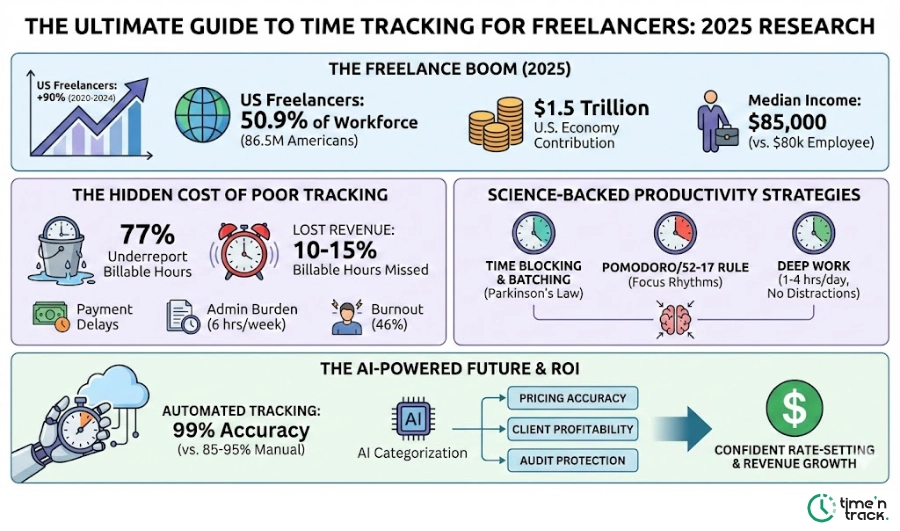
The Six-Figure Freelancer Boom
The freelance workforce is exploding. By 2027, over half the U.S. workforce (86.5 million people) will be freelancing.
But here's the number that matters to you: $85,000. That is the new median income for full-time freelancers, now surpassing traditional employees. Even better? The number of six-figure freelancers jumped 19% in 2025, reaching 5.6 million workers.
The opportunity is massive. But while freelancers report higher productivity—often 7+ productive hours daily vs. just 3 for office workers—backend chaos holds many back from reaching that top income tier.
The "Hidden" Cost of Guessing
Are you leaving money on the table? Only 40% of freelancers use dedicated software for billing. The rest—nearly 38%—rely on memory, spreadsheets, or pure guesswork.
This creates a massive financial leak. Research shows 77% of professionals underreport billable hours when they don't track in real-time. Conversely, using proper tracking tools captures 10–15% more billable hours.
On a $85,000 income, that's over $10,000 a year lost simply because you forgot to start a timer.
The 5 Hurdles You Can Fix Today
Without data, you're flying blind against these common challenges:
- Payment Delays: 85% of freelancers face late payments. Accurate, professional time logs reduce disputes and speed up approval.
- Client Acquisition: 73% struggle to find clients. Efficient tracking frees up time to pitch.
- Admin Overload: Freelancers waste ~6 hours/week on unpaid admin. That's 15% of your work week gone.
- Income Rollercoaster: 40% hate the unpredictability. Data helps you forecast and smooth out cash flow.
- Burnout: 46% suffer from burnout. Tracking helps you enforce work-life boundaries.
3 Strategies to Work Smarter
Successful freelancers don't just work hard; they leverage neuroscience to maximize output.
1. Block and Batch Your Time
Stop reacting to emails all day. Use Time Blocking to dedicate calendar slots to specific work.
- Task Batching: Group low-energy tasks (invoicing, email) together to stop "context switching" from draining your brain.
- Day Theming: Dedicate "Marketing Mondays" or "Finance Fridays" to minimize mental friction.
2. Match Your Energy Cycles
Forget the 9-to-5. Work with your body's rhythm.
- The 52/17 Rule: Top performers work for 52 minutes, then break for 17. This specific ratio keeps energy high all day.
- Ultradian Rhythms: For deep creative work, schedule 90-minute focus blocks.
3. Deep Work vs. Shallow Work
Cal Newport's concept of "Deep Work" is your competitive advantage.
- Stop Multitasking: It takes 23 minutes to refocus after an interruption. Protect your focus blocks.
- Know Your Limits: You only have 1–4 hours of true Deep Work capacity per day. Use them wisely, then switch to shallow tasks.
Why Tracking = Profit
Beyond personal productivity, time tracking is a financial weapon.
Stop Underestimating Projects
We all suffer from the "planning fallacy"—systematically underestimating how long work takes. Historical data fixes this. When you know a website design takes you 15 hours (not the 10 you "feel" it takes), you quote accurately and protect your margin. Use a project quote generator to turn that data into a professional client-ready quote.
Fire Your Worst Clients
Do you know your "true hourly rate"? A client paying $100/hr might actually yield $40/hr if they demand endless unpaid calls and revisions.
- The Fix: Review client profitability quarterly.
- The Goal: Producers should aim for 75–80% billable utilization. Strategists need more buffer, aiming for 60–70%.
Audit-Proof Your Business
For U.S. freelancers, detailed logs are your shield. The IRS requires records for three years. Your time logs are powerful evidence for home office deductions and audit protection.
The 2025 Tech Stack: Smart Tracking
Manual timers are dead. The standard for 2025 is frictionless tracking.
Modern tools now seamlessly integrate with your workflow, categorizing time by client and project without you needing to wrestle with a spreadsheet. This reduces tracking friction to zero and ensures you bill for every minute.
What to look for:
- Seamless Invoicing: Can you turn hours into a paid invoice in one click?
- Privacy-First: Look for local-first storage that respects your data.
- Predictive Analytics: Good tools tell you when you work best, not just how long you worked.
Conclusion: Your Competitive Edge
You cannot improve what you do not measure.
"What gets measured gets managed." — Peter Drucker
The data is clear: Freelancers who track time earn more, stress less, and scale faster.
With modern tools handling the heavy lifting, you have no excuse left. Treat time as your most valuable inventory. In a market of 72.9 million competitors, a data-driven approach is your foundation for success.
Stop guessing. Start tracking. Try Time 'N Track today.

Written by
RaddyWeb developer, designer, and founder of TimeNTrack. With over 10 years of experience helping freelancers run better businesses, Raddy has worked with thousands of people through his Raddy Dev YouTube channel, his blog at raddy.dev, and ran a successful freelance business himself.